The Challenge
Traditional email security analyzes messages in isolation, missing sophisticated attacks that rely on impersonation, compromised accounts, and social engineering rather than malicious links or attachments.
Our Solution
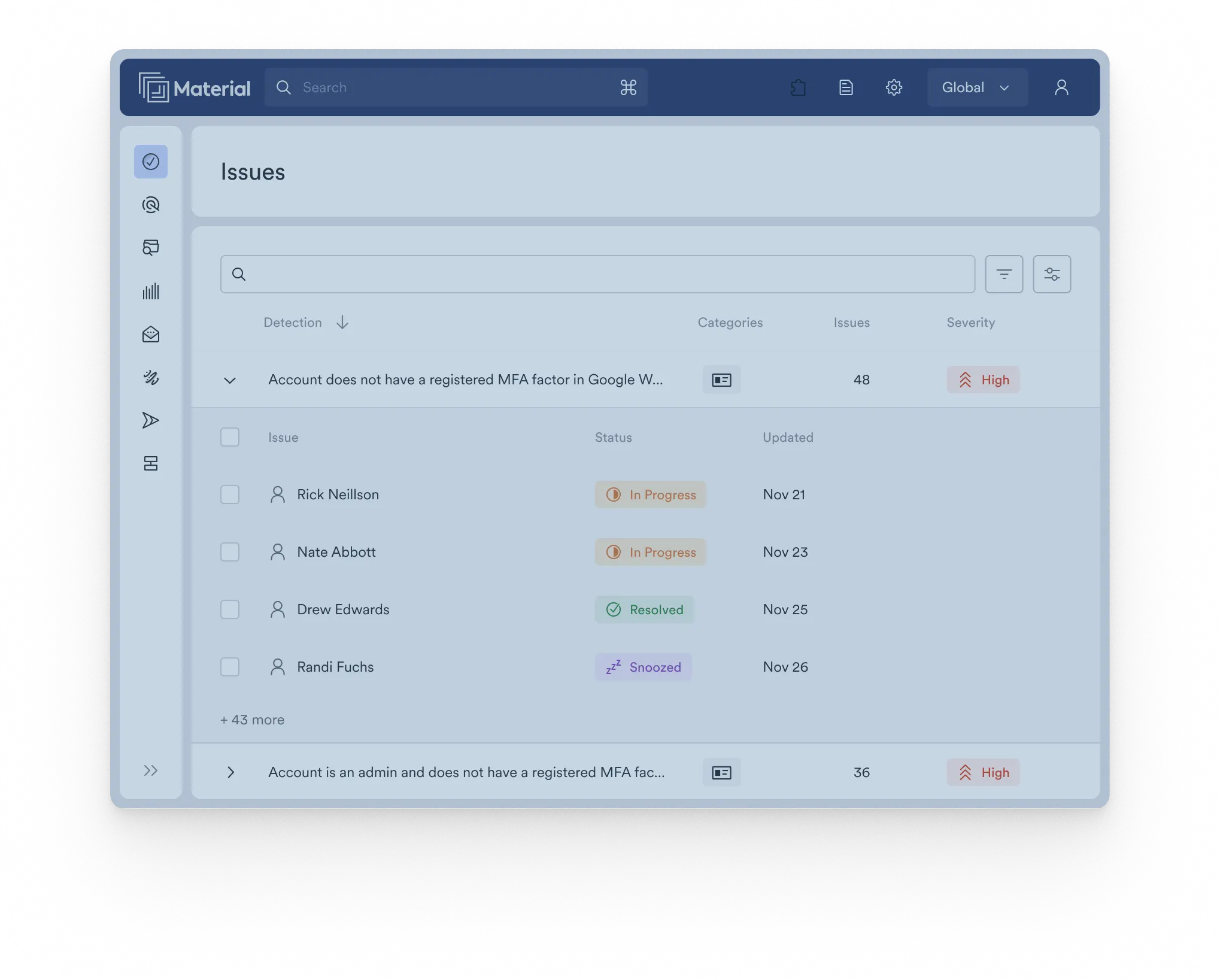
Material combines behavioral, relational, identity, and content signals across the workspace to detect sophisticated email attacks, connect related activity, and automate rapid response.

Hear it from our customers
“I feel a lot more confident about our defenses against phishing and confidential data leakage. Material helps me sleep better at night.”
 Dev Akhawe
Head of Security, Figma
Dev Akhawe
Head of Security, Figma
The Challenge
Traditional security is fighting the last war
Gateway-based email security tools were designed to stop mass-market email spam and malware. They are fundamentally ill-equipped to handle targeted, sophisticated email attacks because they see the world through a keyhole, analyzing each email in isolation.
- Lack of context Traditional tools don't know your organization. They can't tell if a sender is new, if their request is unusual, or if they are impersonating a trusted executive. They lack the relational context to spot social engineering attacks that look legitimate on the surface.
- The rise of payload-less attacks Business Email Compromise (BEC) and Vendor Email Compromise (VEC) are now the most costly types of attacks. They contain no malicious links or files, relying purely on deception to trick employees—making them invisible to scanners looking for traditional malware.
- An over-reliance on the perimeter Perimeter defenses are useless against threats that originate from a compromised employee account. Once an attacker gains a foothold, they can operate undetected inside your environment.
- Fragmented visibility Your security signals are siloed. A risky login alert from your identity provider and a suspicious email are treated as separate events in separate consoles, making it impossible to connect the dots of a coordinated attack.
Our Solution
Multi-layered detection powered by deep environmental context
Material integrates deeply into your cloud workspace, allowing it to build a comprehensive understanding of your environment. This rich context powers a multi-layered detection engine that can identify and stop the attacks that other tools miss.
- Rich behavioral and relational analysis Material builds a baseline of normal communication patterns: who talks to whom, about what, and from where. This allows Material's detection engine to instantly spot anomalies, such as a trusted vendor suddenly emailing from a new geographic location with an unusual request, or a new sender impersonating an executive.
- Advanced content and intent analysis Using Natural Language Processing (NLP) and Large Language Models (LLMs), Material analyzes the content of messages to detect signs of suspicious intent, urgency, impersonation, and social engineering, even in the absence of any links or attachments.
- Unified visibility across the workspace Because Material is API-integrated, it can correlate signals from email with identity and data risk. It can see a risky login, followed by a suspicious email, followed by an attempt to share a sensitive file—and understand it all as a single, cohesive security incident.
- Automated, context-rich response When a threat is detected, Material provides your security team with all the necessary context for rapid investigation and remediation. The ability to automatically find and remove every instance of a threat across all mailboxes condenses hours of manual work into minutes.