
Go back

Assess Your Google Workspace Security Posture in 5 Minutes

Material’s free Google Workspace Security Scorecard is designed to help organizations quickly assess their security posture across email, files, accounts, and global configurations, providing actionable recommendations to mitigate real-world risks.

Industry Insights
October 22, 2025
3m read
3m read
3m listen
3m watch
3m watch
Assess Your Google Workspace Security Posture in 5 MinutesAssess Your Google Workspace Security Posture in 5 Minutes
speakers
speakers
speakers
authors
Rajan Kapoor, VP, Security
participants
No items found.
share

Material’s free Google Workspace Security Scorecard is designed to help organizations quickly assess their security posture across email, files, accounts, and global configurations, providing actionable recommendations to mitigate real-world risks.

Google Workspace is mission-critical infrastructure. It houses your organization's emails, documents, and accounts—the fundamental material your business runs on. But with that centrality comes complexity, and with complexity comes risk.

We've spent years protecting Google Workspace environments at scale, and we've seen the same security gaps appear across organizations of all sizes and industries. Configuration drift, overly permissive sharing settings, weak authentication policies, exposed sensitive information in inboxes and shared files, and subtle email security blind spots—these aren't theoretical vulnerabilities. They're the footholds attackers use to compromise real businesses.

The challenge isn't that security teams don't care about these risks. It's that Google Workspace security spans so many domains—email, files, identity, and global configurations—that it's difficult to maintain a complete picture of your posture, especially as your organization scales and your workspace evolves.

That's why we built a free Google Workspace Security Scorecard.
What the Assessment Covers

The self-assessment consists of 25 questions that examine security practices across four critical areas:

Email Security: How well is your inbox protected from phishing, business email compromise, and malicious messages that bypass native controls?

File Security: Are your Drive files and documents properly governed? How easily can you determine who has access to what, and what sensitive files are at risk of overexposure?

Account Security: How hardened are your user accounts against compromise? What happens when credentials are stolen or accounts are hijacked?

Global Configurations: Are your workspace-wide settings properly configured to reduce attack surface and enforce security policies?

Each question is based on real-world security incidents and misconfigurations we've observed protecting Google Workspace environments. The assessment doesn't require any technical integration or access to your workspace—just your knowledge of your current security practices.

What You'll Learn

When you complete the assessment, you'll receive:

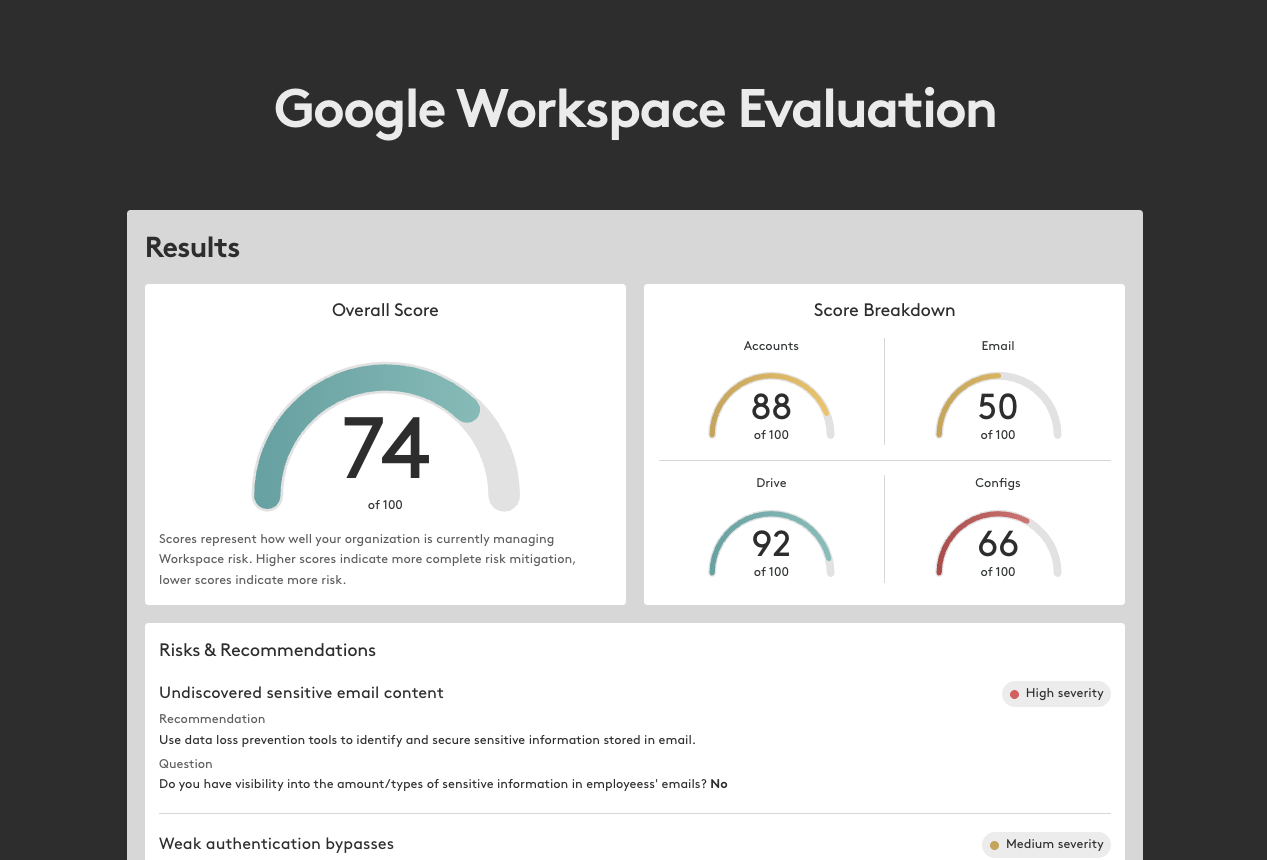
  • An overall risk score that benchmarks your current Google Workspace security posture
  • Domain-specific risk scores for email, files, accounts, and configurations
  • Detailed risk analysis for each answer that indicates potential vulnerabilities
  • Actionable recommendations for improving your security posture in areas where you have exposure

The assessment is designed to be practical, not punitive. Our goal isn't to generate a failing grade—it's to help you understand where your risks lie and what you can do about them.

Why This Matters Now

Google Workspace attacks are becoming more sophisticated. Attackers know these platforms are critical infrastructure, and they've adapted their tactics accordingly. Phishing campaigns bypass traditional email security. Stolen credentials give attackers native access to your environment. Misconfigured sharing settings expose sensitive data. And because Google Workspace is designed for collaboration, the blast radius of a single compromise can be enormous.

The organizations that best defend against these threats aren't necessarily the ones with the biggest security budgets. They're the ones that understand their risk profile and address gaps systematically. This assessment gives you a clear starting point.

Take the Assessment

Whether you're a security engineer managing day-to-day workspace security, a CISO evaluating your organization's cloud security posture, or an IT leader responsible for Google Workspace administration, this assessment will give you actionable insights in just five minutes.

Take the Google Workspace Security Self-Assessment →

Your Google Workspace is what your business is made of. Make sure it's protected.

Frequently Asked Questions

Find answers to common questions and get the details you need.

No items found.

Related posts

Our blog is your destination for expert insights, practical tips, and the latest news in technology. Stay informed with our regular updates and in-depth articles. Join the conversation and enhance your understanding of the tech landscape.

blog post

The Quiet Phish: Stopping Calendar Invitation Attacks

Learn how to mitigate the risk posted by calendar invitation attacks against Google Workspace and Microsoft 365 accounts.

Rajan Kapoor, VP, Security
5
m read
Read post
Podcast

The Quiet Phish: Stopping Calendar Invitation Attacks

Learn how to mitigate the risk posted by calendar invitation attacks against Google Workspace and Microsoft 365 accounts.

5
m listen
Listen to episode
Video

The Quiet Phish: Stopping Calendar Invitation Attacks

Learn how to mitigate the risk posted by calendar invitation attacks against Google Workspace and Microsoft 365 accounts.

5
m watch
Watch video
Downloads

The Quiet Phish: Stopping Calendar Invitation Attacks

Learn how to mitigate the risk posted by calendar invitation attacks against Google Workspace and Microsoft 365 accounts.

5
m listen
Watch video
Webinar

The Quiet Phish: Stopping Calendar Invitation Attacks

Learn how to mitigate the risk posted by calendar invitation attacks against Google Workspace and Microsoft 365 accounts.

5
m listen
Listen episode
blog post

A Time to Build, a Time to Buy - How to Make a Choice

Building security tools in-house is seductive but often leads to costly, resource-draining tech debt, making buying a customizable platform the smarter choice unless the problem involves unique trust issues, an unserved market, or highly specialized environment logic.

Rajan Kapoor, VP, Security
m read
Read post
Podcast

A Time to Build, a Time to Buy - How to Make a Choice

Building security tools in-house is seductive but often leads to costly, resource-draining tech debt, making buying a customizable platform the smarter choice unless the problem involves unique trust issues, an unserved market, or highly specialized environment logic.

m listen
Listen to episode
Video

A Time to Build, a Time to Buy - How to Make a Choice

Building security tools in-house is seductive but often leads to costly, resource-draining tech debt, making buying a customizable platform the smarter choice unless the problem involves unique trust issues, an unserved market, or highly specialized environment logic.

m watch
Watch video
Downloads

A Time to Build, a Time to Buy - How to Make a Choice

Building security tools in-house is seductive but often leads to costly, resource-draining tech debt, making buying a customizable platform the smarter choice unless the problem involves unique trust issues, an unserved market, or highly specialized environment logic.

m listen
Watch video
Webinar

A Time to Build, a Time to Buy - How to Make a Choice

Building security tools in-house is seductive but often leads to costly, resource-draining tech debt, making buying a customizable platform the smarter choice unless the problem involves unique trust issues, an unserved market, or highly specialized environment logic.

m listen
Listen episode
blog post

Context Is Everything: Sharpening Account Takeover Detection with Network Intelligence

Material elevates Account Takeover (ATO) detection beyond basic IP logging by integrating real-time network intelligence from Spur, instantly differentiating legitimate remote work from sophisticated proxy-based attacks.

Mike Moran, Ph.D.
7
m read
Read post
Podcast

Context Is Everything: Sharpening Account Takeover Detection with Network Intelligence

Material elevates Account Takeover (ATO) detection beyond basic IP logging by integrating real-time network intelligence from Spur, instantly differentiating legitimate remote work from sophisticated proxy-based attacks.

7
m listen
Listen to episode
Video

Context Is Everything: Sharpening Account Takeover Detection with Network Intelligence

Material elevates Account Takeover (ATO) detection beyond basic IP logging by integrating real-time network intelligence from Spur, instantly differentiating legitimate remote work from sophisticated proxy-based attacks.

7
m watch
Watch video
Downloads

Context Is Everything: Sharpening Account Takeover Detection with Network Intelligence

Material elevates Account Takeover (ATO) detection beyond basic IP logging by integrating real-time network intelligence from Spur, instantly differentiating legitimate remote work from sophisticated proxy-based attacks.

7
m listen
Watch video
Webinar

Context Is Everything: Sharpening Account Takeover Detection with Network Intelligence

Material elevates Account Takeover (ATO) detection beyond basic IP logging by integrating real-time network intelligence from Spur, instantly differentiating legitimate remote work from sophisticated proxy-based attacks.

7
m listen
Listen episode
blog post

Beyond Block: Why Your Security Stack Needs More Verbs, not More Tools

Modern security demands organizations stop relying on perimeter blocking and adopt a richer vocabulary of proactive capabilities to manage risk dynamically inside collaborative cloud environments.

Nate Abbott
3
m read
Read post
Podcast

Beyond Block: Why Your Security Stack Needs More Verbs, not More Tools

Modern security demands organizations stop relying on perimeter blocking and adopt a richer vocabulary of proactive capabilities to manage risk dynamically inside collaborative cloud environments.

3
m listen
Listen to episode
Video

Beyond Block: Why Your Security Stack Needs More Verbs, not More Tools

Modern security demands organizations stop relying on perimeter blocking and adopt a richer vocabulary of proactive capabilities to manage risk dynamically inside collaborative cloud environments.

3
m watch
Watch video
Downloads

Beyond Block: Why Your Security Stack Needs More Verbs, not More Tools

Modern security demands organizations stop relying on perimeter blocking and adopt a richer vocabulary of proactive capabilities to manage risk dynamically inside collaborative cloud environments.

3
m listen
Watch video
Webinar

Beyond Block: Why Your Security Stack Needs More Verbs, not More Tools

Modern security demands organizations stop relying on perimeter blocking and adopt a richer vocabulary of proactive capabilities to manage risk dynamically inside collaborative cloud environments.

3
m listen
Listen episode
Privacy Preference Center

By clicking “Accept”, you agree to the storing of cookies on your device to enhance site navigation, analyze site usage, and assist in our marketing efforts. View our Privacy Policy for more information.

New