OAuth Security

OAuth Security for the AI Agent Era
Stop malicious OAuth apps before they reach your data. Material's OAuth Remediation Agent watches third-party clients and AI agents across Google Workspace, classifies risk in real time, and revokes access tokens the moment behavior turns suspicious.
Abstract overlay image with black, blue, and red circles Abstract overlay image with black, blue, and red circles Abstract overlay image with black, blue, and red circles Abstract background image with a curved blue dashed line over a black rectangle
Abstract grid of rectangles with a red dashed rectangle breaking the otherwise uniform layout

Persistent OAuth risk is 
the new phishing

Over-permissioned access tokens have become the most overlooked path into the cloud workspace. OAuth tokens survive password resets, MFA challenges, and routine offboarding, so a single phished consent screen can hand an attacker persistent access to Gmail and Drive without triggering a login alert. These patterns now go by names like consent phishing and OAuth sprawl, and they share a common signature: legitimate authorization plumbing used against the workspace it was meant to enable.

Blocking every new OAuth client outright is not realistic when the same framework powers every AI agent your team wants to adopt. Material closes the gap with continuous behavioral analysis rather than point-in-time scope reviews.

Continuous OAuth Monitoring

Material instantly detects new OAuth grants and continuously audits existing access, performing the deep investigation an analyst would otherwise run by hand. The agent surfaces shadow IT and unsanctioned AI agents that users authorized without admin approval. Pair this with shadow IT and unauthorized AI controls for full visibility into self-adopted clients.


Learn more

Deep Risk Classification

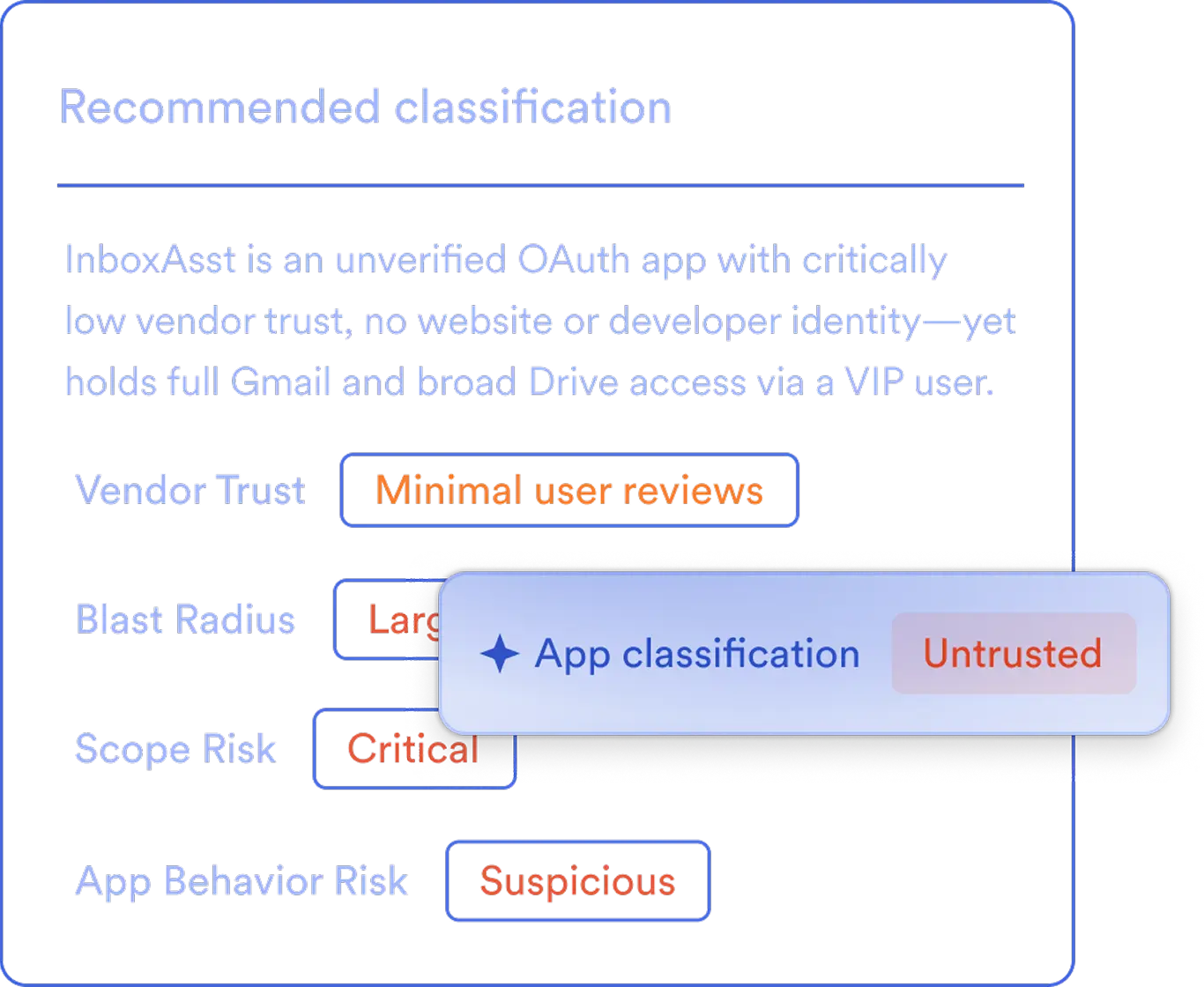
The agent automatically classifies each connection by severity, risk, and business impact. Classifications factor in the OAuth scopes an apprequested, how it behaves at runtime (its actual activity), vendor trust, reputation signals, and known OAuth vulnerabilities (a known publisher with a track record versus a brand-new shop), and potential blast radius across your data. Your team works the riskiest apps first instead of reviewing alphabetically.

Learn more

Automated Kill Switch and User Verification

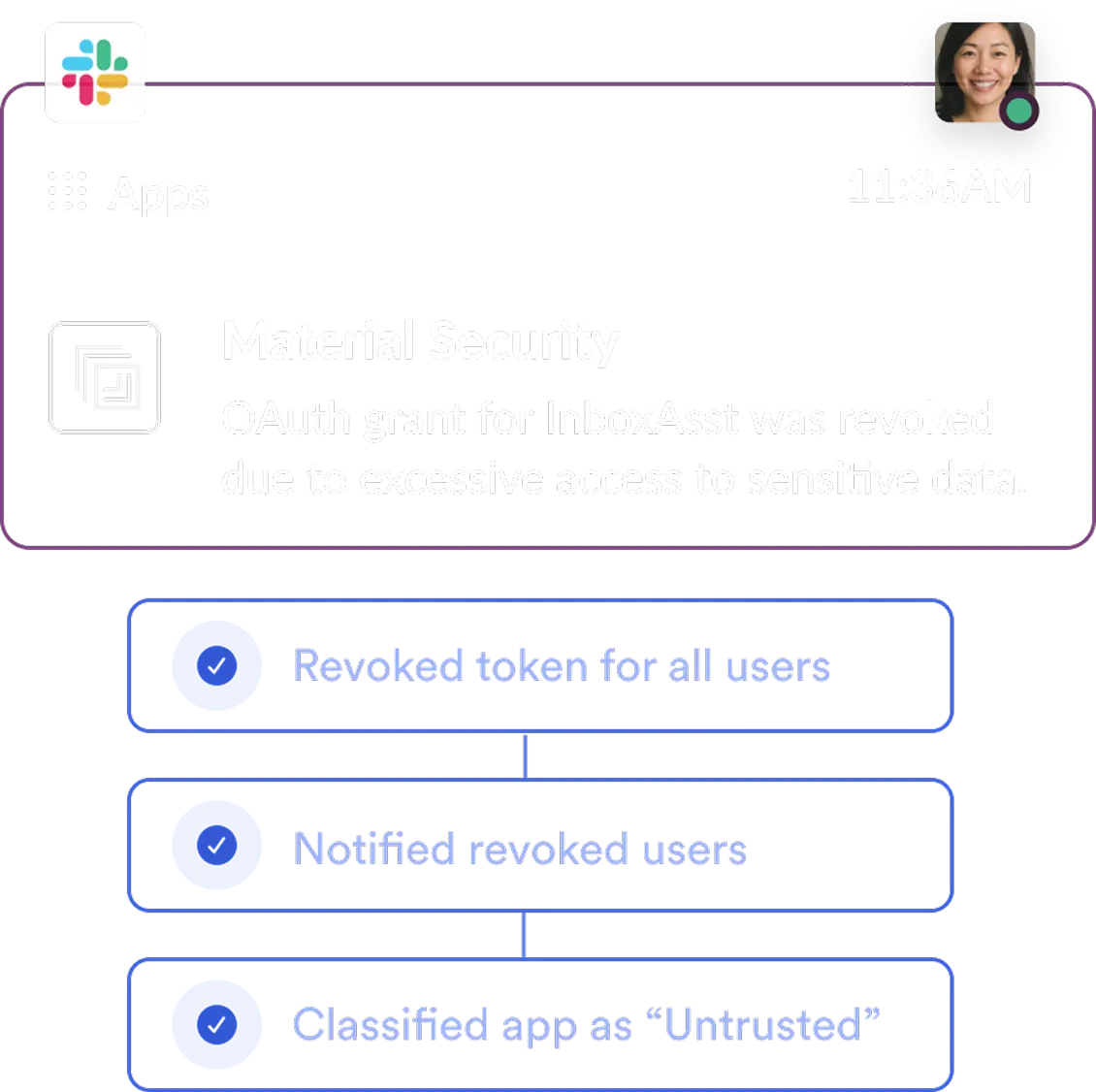
The agent can programmatically revoke OAuth tokens autonomously, flag critical risks for human review, and message the user in Slack to confirm whether an authorization was legitimate. For business-critical clients, you can require analyst approval before revocation happens, a human-in-the-loop safeguard that protects the company from accidental disruption while still moving fast on confirmed threats. This is how Material helps teams stop token-based persistence and data exfiltration without adding triage burden.
Learn more

Continuous OAuth Monitoring

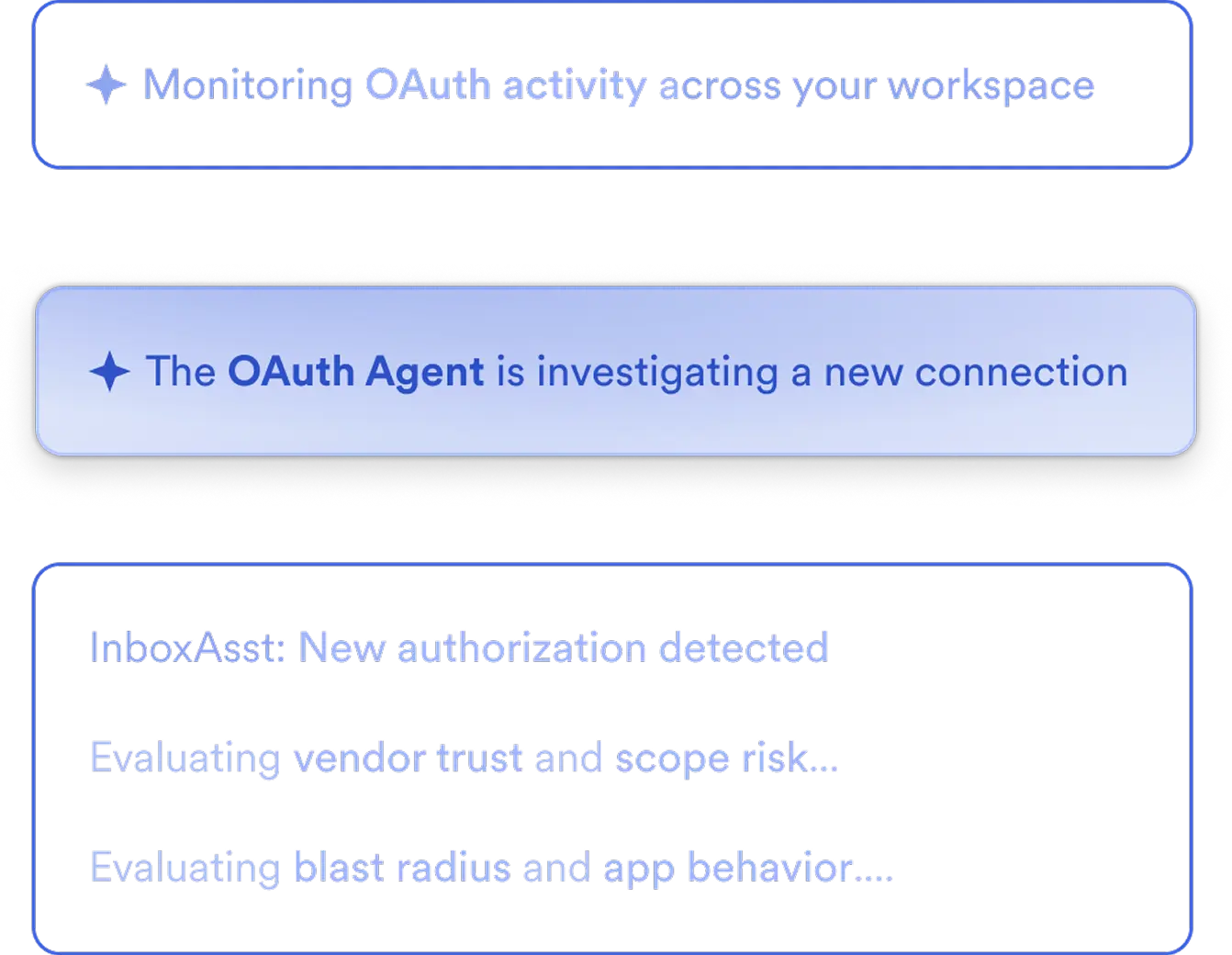
Material continuously monitors OAuth activity across your workspace, evaluating new connections across a comprehensive set of criteria.

Behavioral Anomaly Detection

Material continuously baselines normal activity and flags offensive patterns as they emerge, providing clear context and a risk analysis for every detection.

Automated Kill Switch and User Verification

Programmatically revoke OAuth tokens upon detection of critical threats. The agent works directly with your users in Slack to verify new installations, saving your security team the toil of chasing basic answers.

Real-time protection vs polling and post-mortems

Legacy SSPM applies an outdated Shadow IT playbook to a modern security problem.
Legacy SSPM
Material OAuth
Apps Agent
Detection Method
API Polling (Hourly)
Real-time Event Streams
Primary Goal
Compliance & Inventory
Active Threat Defense
Response
Post-mortem Report
Instant Token Revocation
User Impact
Slow manual reviews or outright blocks
Crowdsourced Triage via Slack
Legacy SSPM
Detection Method
API Polling (Hourly)
Primary Goal
Compliance & Inventory
Response
Post-mortem Report
User Impact
Slow manual reviews or outright blocks
Material OAuth
Apps Agent
Detection Method
Real-time Event Streams
Primary Goal
Active Threat Defense
Response
Instant Token Revocation
User Impact
Crowdsourced Triage via Slack

Reduce effort while
maintaining control of AI

OAuth is the primary way AI agents reach cloud workspace data. With the number of connections end users authorize every week, security teams are losing track of which grants are still in use, which have escalated their scopes, and which are still connected to offboarded accounts. Material's OAuth Remediation Agent makes it easier to accept the good, reject the bad, and investigate the uncertain.
Think of it as a full-time AI analyst extending your team, auditing each new client, collecting user justifications, and recommending classifications based on real authentication and runtime behavior. The agent works alongside Material's account security, email security, and file security products to correlate OAuth activity with identity and content signals that an app-level tool in isolation would miss.
OAuth Risk

You’ve locked the front door. Don't leave the OAuth window open.

Join the world’s most sophisticated security teams using Material to protect their cloud office.
Get a demo

OAuth Security FAQ

OAuth security is how organizations govern third-party application access granted through the OAuth 2.0 protocol. OAuth lets a client app obtain an access token to act on behalf of a user without handling the user's credentials, which is why unreviewed or over-scoped grants are a direct path into Gmail, Drive, and other cloud workspace data. Effective OAuth security combines continuous discovery of authorized clients, runtime behavior analysis, and the ability to revoke tokens immediately when something turns malicious.

When a user installs a third-party app, the app sends an authorization request to the workspace's authorization server (like Google). The user sees a consent screen listing the requested scopes and approves them. The authorization server returns an authorization code, which the client exchanges for an access token, presenting its client id and client credentials. The client uses that access token to call APIs against protected resources like Gmail. Refresh tokens let the client renew access without prompting the user again, which is the source of most OAuth persistence problems.

An OAuth access token is a credential a client application presents to an API to prove it has been authorized to act on a user's behalf. Access tokens are typically short-lived bearer tokens, meaning anyone in possession of the token can use it until it expires or is revoked. Most OAuth breaches involve attackers obtaining valid access tokens (or the refresh tokens used to renew them) and using them to read email, exfiltrate files, or call APIs without triggering a new authentication event.

Consent phishing is a social engineering attack where a malicious OAuth client tricks a user into approving an authorization request, typically by impersonating a legitimate vendor on the consent screen. Because the user technically approves the grant themselves, the attacker walks away with a valid access token and the activity bypasses traditional credential-theft alerts. Continuous monitoring of new OAuth grants is the only reliable defense, since the attack succeeds at the consent step rather than the login step.

Most OAuth breaches follow one of three patterns. A user is tricked into approving a malicious app through consent phishing. A legitimate third-party vendor with valid OAuth grants is compromised, and the attacker uses those existing tokens to reach customer data (the pattern behind the Vercel and Heroku-Travis CI incidents). Or long-forgotten apps with broad scopes are exploited months or years after the original authorization. All three bypass MFA because the attacker is using a valid token, not logging in.

MFA does not stop OAuth abuse because a valid access token survives password resets and MFA resets. Once a user has approved a malicious client, the attacker holds a working token that calls APIs directly, never triggering a fresh login or multi-factor authentication challenge. The only reliable response is revoking the token at the authorization server, which is what Material automates.

OAuth sprawl is the accumulation of hundreds or thousands of authorized clients across an organization, each with different scopes and authorized by different users at different times. It grows fastest in environments that have adopted AI tools quickly. Material's research on OAuth app sprawl in Google Workspace covers the dynamic in detail.

Traditional SSPM tools poll for permission snapshots and flag broad scopes after the fact. Material monitors what each authorized client is actually doing inside the workspace and can revoke tokens the moment behavior turns suspicious. The difference is active defense versus a compliance report.

Yes. AI agents authenticate through the same OAuth flows as any other client, so they get the same continuous discovery, classification, and automated revocation as traditional SaaS integrations.

New