Cloud Workspace Security

Why Cloud Workspace Security?

The cloud workspace sprawled beyond email long ago, becoming a web of productivity, communication, and risk. AI adoption has only accelerated both the sprawl and the risk. Defending it with point solutions leaves the same gaps within the platform vulnerable.
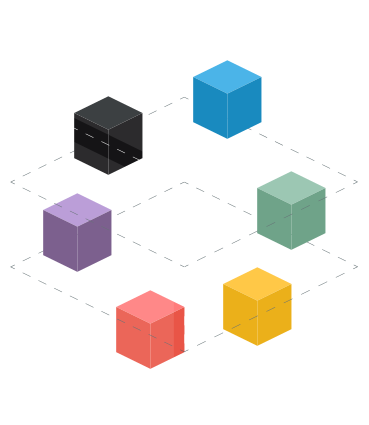
Connected blocks representing an interconnected cloud workspace

The world's most innovative companies are protecting the cloud workspace

One workspace.
One system to defend it.

The cloud workspace is one system, and attackers treat it that way: a single compromised session reaches shared drives, calendars, connected SaaS apps, and now AI agents. Phishing still matters, but email-only tools defend one door in a building with many, and a patchwork of partial tools can't surface subtle signs of intrusion. Material defends the whole building — resilience before, detection and response during, containment after.

In the beginning…
Forty years ago, the workspace was mostly physical, and email was the attacker's best way into it.
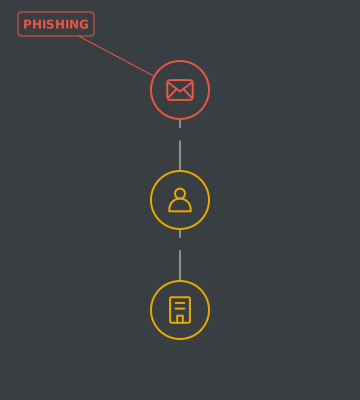
01In the beginning

Forty years ago, the workspace was mostly physical, and email was the attacker's best way into it.

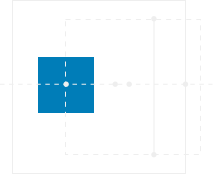
A phishing attack enters email, which connects to an identity and the physical office.
02The right answer then

Put a gateway in front of the inbox and most attacks stopped at the door. Securing email was securing the workspace.
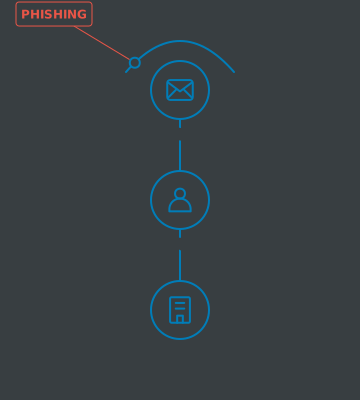
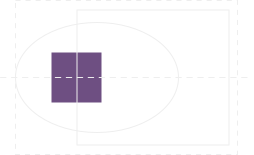
A gateway blocks phishing before it reaches email, protecting the connected identity and office.
03The workspace expanded

The workspace drastically changed and the threat surface exploded, but security didn't keep up.
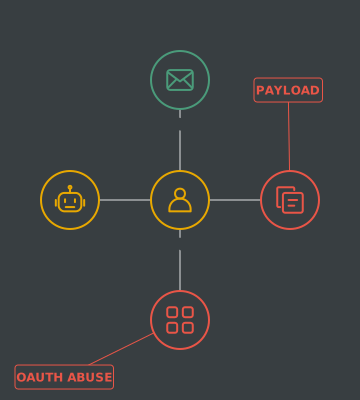
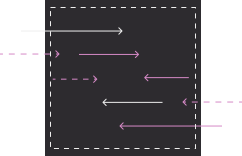
Email, identity, files, apps, and AI form an interconnected workspace with attacks entering through multiple surfaces.
04The fractured stack

Point solutions for identity, data, and app security help. But the fragmented patchwork leaves holes, slows response, and struggles to stop threats once they're past the perimeter.
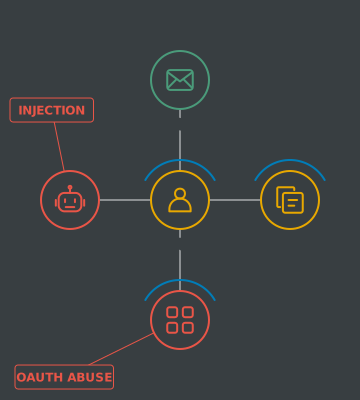
Separate, incomplete defenses protect individual surfaces but leave gaps between them.
05The way forward

Cloud workspace security provides total coverage and interconnected prevention, detection, and response across the entire workspace to stop attacks, minimize risk, contain breaches faster, and adopt AI safely.
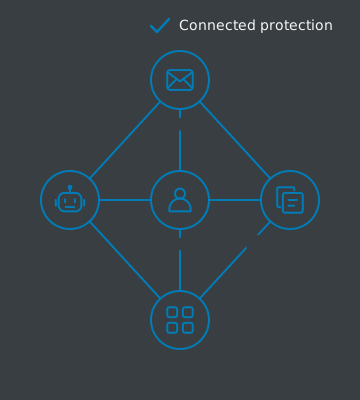
One connected protection system covers email, identity, files and data, apps, and AI.

Nobody budgeted for this workload

Shared files, OAuth grants, forwarding rules, session tokens: the cloud workspace has been quietly compounding risk with no attacker required. It's the ordinary consequence of people sharing documents, connecting apps, and adopting tools to get their jobs done. The problem is that it happens at a velocity that's impossible to track manually.

25%

of connected OAuth apps hold restricted scopes, often read/write to email and shared files.

1100%

growth in sensitive files in share drives over an eight-month period: more than triple the rate of files overall.

45%

of security professionals neglect OAuth app governance, while a further 33% rely solely on manual reviews.

13x

increase in phishing in the AI era: there's more phishing volume, and the attacks themselves are more sophisticated.

The inherent risk in the cloud workspace is compounded by rising attack volume against those surfaces, and by how much of the defense still depends on manual review. Malicious and compromised OAuth apps. Missing data governance over what agentic tools can touch. Phishing that keeps getting harder to catch by hand. None of it holds up as a manual process.

The Material Difference

Hear it from our customers

I think it’s important to look at the cloud office at a wider holistic level and not just at the point of entry. Understanding its whole life cycle and even what’s being done with it when resting is critical to protecting that platform. Material does that very well.

Dan Ayala
Dan Ayala
Chief Security & Trust Officer
We knew critical aspects of Google's Workspace native security wouldn't scale as our company got bigger, which is why we came to Material.

Frank Wang
Frank Wang
Lead Security Engineer
I've seen amazing improvements in our ability to react, relying on well-trusted mechanisms from Material. With just one click, we can disable phishing emails.

Devdatta Akhawe
Devdatta Akhawe
Head of Security

FAQ

Frequently asked questions

We already have DLP for our data. Why do we need this too?

DLP inspects content and blocks policy violations. It was never built to connect that to who has access to the account holding the data, whether that account shows signs of compromise, or what an attacker could actually reach once inside. Material starts where DLP stops: tying data sensitivity to the identity and access layer DLP doesn't touch.

Our IdP and ITDR already flag identity threats. What's left for you to catch?

IdP and ITDR watch authentication: logins, MFA, known attack patterns. AiTM phishing hands an attacker a valid session token that clears every identity check they run. The moment that matters, what the account does after that session is live, is the layer neither tool sees.

We run an SSPM for our SaaS and AI app sprawl. Isn't that the same as your OAuth monitoring?

Most SSPM gives you an inventory: which apps connected, what scopes they requested. That's a compliance snapshot, not a defense. Material watches what a connected app actually does at runtime and can revoke a token the moment behavior turns malicious. Inventory tells you what exists. This tells you what to do about it.

We're a lean team already juggling five security tools. Why add a sixth?

It's not a sixth tool watching a sixth fragment. It's one platform watching email, files, accounts, and connected apps as the interconnected system they actually are, so a two-person team spends attention on real incidents instead of correlating five dashboards by hand.

How is this different from just turning on more Google or Microsoft native security features?

Native controls are a genuinely strong foundation, and this doesn't replace them. But they were built to secure the platform, not to give a security team a correlated posture: no cross-surface correlation between email, identity, and file events, and no runtime behavior monitoring for OAuth grants. Material closes exactly those gaps via API.

We already have a SIEM pulling logs from everywhere. Isn't this redundant?

A SIEM ingests logs and sees events. It has no native understanding of how email, identity, files, and OAuth relate inside the workspace itself. Material goes deeper than log data allows and can feed high-fidelity workspace signal into the SIEM teams already have. It's not competing with it, it's making it smarter about the one part of the environment it can't see well.

Get a demo

See the whole picture of your cloud workspace

Book a demo
Privacy Preference Center

By clicking “Accept”, you agree to the storing of cookies on your device to enhance site navigation, analyze site usage, and assist in our marketing efforts. View our Privacy Policy for more information.

New