The Challenge
Employees connect new apps and AI tools to the workspace constantly, and most of those grants are never revisited, leaving a sprawling, mostly invisible attack surface behind every login.
Our Solution
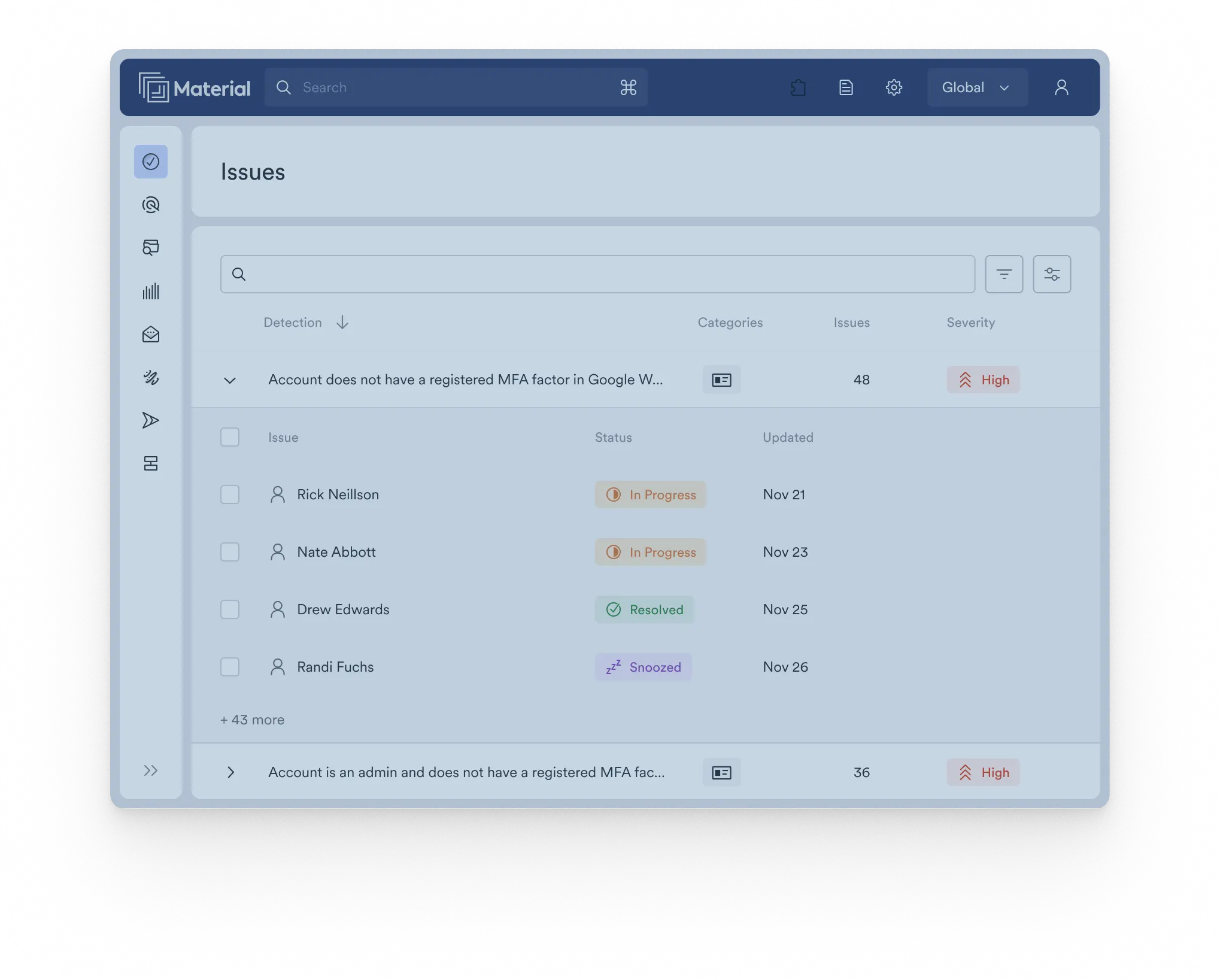
Material continuously discovers every third-party and AI app connected to the workspace, evaluates each one by its real behavior and blast radius rather than its stated permissions, and gives security teams one-click remediation to revoke what doesn't belong.

Hear it from our customers
“With other tools, there was no real analysis. There was no interactivity. Material has made a huge difference along those lines for us. This is exactly what we want everybody to do.”
.jpeg) Robert Santos
Head of IT
Robert Santos
Head of IT
The Challenge
OAuth grants accumulate faster than anyone can review them
Every time an employee signs into a new tool with their work Google or Microsoft account, or grants a third-party app read access to their Drive, another OAuth connection joins the environment. Most of these grants are legitimate. Some are stale, over-permissioned, or outright malicious. Almost none of them get reviewed again after the initial click.
- No Inventory, No Starting Point Security teams can't govern what they can't see, and most have no reliable list of every third-party and AI app connected to the workspace, let alone what each one can actually access.
- Permission Scope Isn't the Same as Risk A tool with narrow permissions can still behave maliciously, and a tool with broad permissions might be perfectly safe. Knowing what an app was granted says nothing about what it's actually doing with that access.
- Stale Grants Pile Up Silently Apps get connected for a single use case and never disconnected. Former employees' integrations, abandoned pilots, and long-forgotten scripts keep valid, often over-permissioned tokens active indefinitely.
- Manual Review Doesn't Scale Vetting each connection by hand, one message to the employee at a time, works for a handful of apps a month. It falls apart entirely at the pace employees actually adopt new tools.
Our Solution
See what's connected, and what it's actually doing

Material's OAuth Threat Remediation Agent goes beyond a static list of connected apps and their requested scopes, which is table stakes at this point. It continuously monitors what each connected app actually does with its access: the API calls it makes, the data it touches, and how that behavior compares to what a legitimate instance of that app should be doing. When an app's behavior crosses a risk threshold, Material can revoke its access automatically or route it to a human for review.
- Comprehensive Discovery, No Agent Required Material detects every third-party service and AI tool employees connect using their work identity, including apps that were never sanctioned or reviewed by IT.
- Risk Assessed by Behavior, Not Just Permission Material evaluates what a connected app can reach today, and monitors what it's actually doing with that access in real time, so a legitimate-looking app that starts behaving like reconnaissance software gets caught even if its permissions look fine on paper.
- Blast Radius in Context Material combines app risk with account-level context, so a marketing tool with read access to a junior employee's calendar is treated differently than the same tool connected to a finance lead with access to sensitive financial data.
- Revoke in One Click, or Automatically Security teams can review flagged connections and revoke access instantly from the Material console, or configure policies that automatically revoke tokens the moment a high-risk threshold is crossed.